

Live events venues scheduled 13.1% more shifts in December 2025 than in November, data from Bournemouth's StaffSavvy shows. Hours rose by more than 52,500.
Live events and performing arts venues scheduled 13.1% more shifts in December 2025 than in November, according to scheduling records analysed by Bournemouth workforce-management company StaffSavvy.
Overview
- Across 53 live events and performing arts operators, scheduled shifts rose from 79,769 in November 2025 to 90,244 in December.
- That is 9.5% more per calendar day, once December’s extra day is allowed for.
- Time on the rota rose by more than 52,500 hours, and the estimated labour cost by about £673,000.
- The figures cover the whole sample, not individual Bournemouth venues.
What the records show
StaffSavvy compared November and December scheduling records from 53 operators for each year from 2021 to 2025. Total time on the rota went from 455,578 hours in November 2025 to 508,101 in December, a rise of 11.5%. Hours logged through time entries, the time staff actually clocked, rose 12.1%, from 436,508 to 489,213.
The company’s estimated labour cost figure rose 14.6%, from £4.61 million in November to £5.28 million in December.
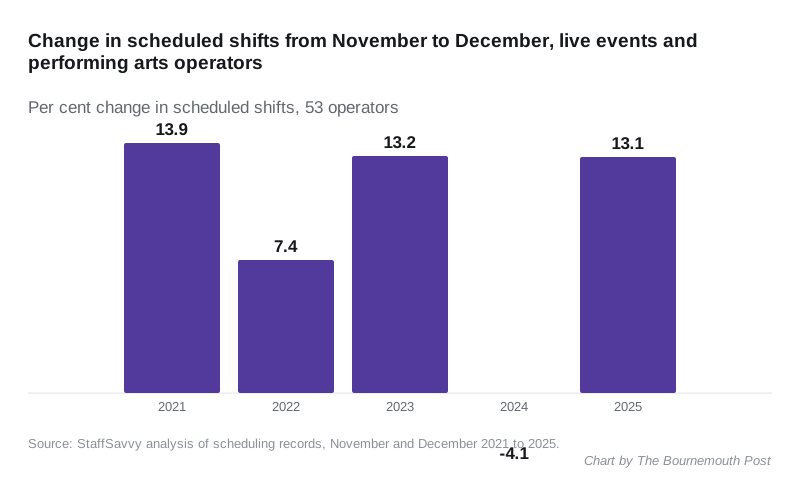
December was busier than November in four of the five years. The rise was around 13% or more in three of them, and the five-year average was 8.7%, with each year counted equally. The one fall came in 2024.
| Year | November shifts | December shifts | Change |
|---|---|---|---|
| 2021 | 12,051 | 13,723 | +13.9% |
| 2022 | 25,987 | 27,917 | +7.4% |
| 2023 | 32,013 | 36,231 | +13.2% |
| 2024 | 49,662 | 47,607 | −4.1% |
| 2025 | 79,769 | 90,244 | +13.1% |
The 2026 figures so far point the same way. Scheduled shifts rose 16.4% from September to October this year, from 81,860 to 95,289.
Separate research in the Society of London Theatre and UK Theatre 2025 report found that December brought around three times as many performances and attendances as August across a sample of 48 regional venues.
Where the pressure falls
For a theatre running a matinee and an evening show, the squeeze often comes between the two: one audience leaving, the auditorium being reset and the next crowd arriving.
Andrew Treadwell, StaffSavvy’s founder, began developing the software while he was studying at Bournemouth University and working as a student production manager at The Old Fire Station. He stayed in Bournemouth after graduating and built the business alongside his agency career.
“Filling the rota is only half the battle, hidden overtime and minimal call times can heavily increase your staffing spend,” he said. “Using a dynamic budgeting tool can help you keep on budget each step of the way; from initial automated scheduling through to on the day changes. Keeping each day on budget soon makes a difference.”
Three steps for venue managers this Christmas
The company suggests three things venues can do:
- Plan where people are needed across each shift. Bring staff availability, rotas and position assignments into one plan, so gaps and overlaps show up early and last-minute cover is needed less often.
- Let staff update their availability and swap shifts easily. Publish rotas early and allow straightforward swaps within clear rules on training, availability and contracted hours, so managers spend less time chasing replies.
- Check the rota against the hours actually worked. Review time entries after busy weekends. If the reset regularly overruns, or the same team keeps working overtime, adjust the next rota.
The analysis covers all scheduled shifts at the 53 operators, for November and December from 2021 to 2025 and for September and October 2026. The 13% figure is based on the 2025 pattern.
Sponsored feature for StaffSavvy, the Bournemouth workforce-management company.
Have your say