
BCP schools permanently excluded 96 pupils in 2025/26, down from 100. The rate is still above England's, and pupils got 6,329 suspensions between them.
Schools in Bournemouth, Christchurch and Poole permanently excluded 96 pupils in the 2025/26 school year. That is down from 100 the year before, but still well above the 60 recorded in 2019/20.
The figures are provisional. They come from a School Exclusions report to BCP Council’s Children’s Services Overview and Scrutiny Committee, which meets on Tuesday 24 November.
The report says BCP’s permanent exclusion rate is still above the averages for England, the South West and similar councils. Pupils on SEN support, pupils eligible for free school meals and children known to social care are excluded far more often than others.
Overview
- Permanent exclusions: 96 in 2025/26 (provisional), down from 100 in 2024/25 and a peak of 119 in 2022/23.
- How BCP compares: 0.19 per 100 pupils in 2024/25, against 0.12 for England and the South West and 0.09 for similar councils.
- Suspensions: 6,329 in 2025/26, given to 1,930 pupils. Down slightly from 6,445 in 2024/25.
- Who is excluded: 84 of the 96 were from secondary schools. 59 were eligible for free school meals and 46 were on SEN support.
- Cost: placements for permanently excluded pupils cost £3.15m in 2025/26, up from £0.97m in 2021/22.
Permanent exclusions, year by year
A permanent exclusion means a child is removed from the school’s roll and has to be educated somewhere else. The council must arrange that education from the sixth school day.
The report gives these totals for BCP:
| School year | Permanent exclusions |
|---|---|
| 2019/20 | 60 |
| 2020/21 | 48 |
| 2022/23 | 119 (peak) |
| 2023/24 | 91 |
| 2024/25 | 100 |
| 2025/26 (provisional) | 96 |
The report puts the dip in 2020/21 down to pandemic school closures. It does not give a 2021/22 total in its text.
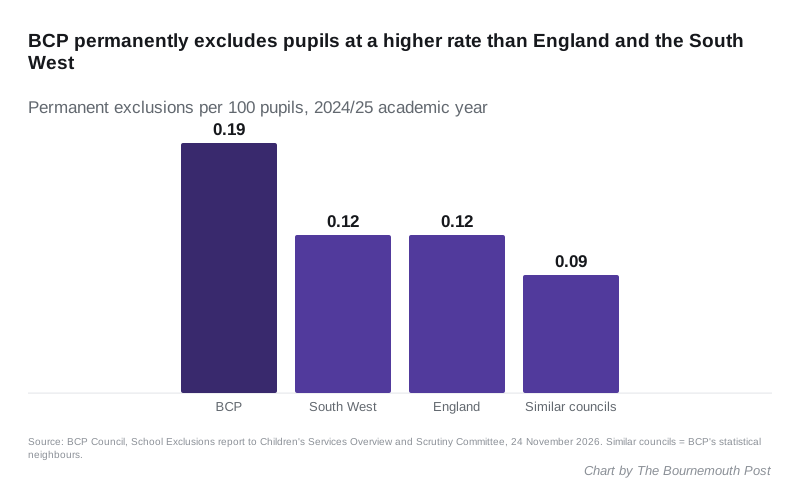
In 2024/25 BCP’s rate of 0.19 per 100 pupils was more than double the 0.09 average for its statistical neighbours, the councils the government judges most similar to it. The rate for England and for the South West was 0.12.
Which pupils were excluded in 2025/26
Of the 96 pupils permanently excluded last year:
- 84 were at secondary schools, 11 at primary schools and one at a special school
- the exclusions came from 33 different schools
- 72 were in Years 8, 9 and 10, and Year 9 had the most, with 27
- just under two thirds were boys
- 59 (62%) were eligible for free school meals
- 46 were receiving SEN support and eight had an education, health and care plan (EHCP)
- eight had a Child in Need plan and nine had a Child Protection plan
The report notes that rates for small groups, such as individual primary year groups, can swing on one or two pupils.
The council’s figures also show big differences across the area. BCP groups its schools into ten clusters. The Bournemouth West cluster had a provisional permanent exclusion rate of 0.49, about five times the cluster average of 0.10. Poole North (0.29), Poole East (0.22) and Poole South (0.21) were also high. Bournemouth Town Centre (0.08) and Poole Central (0.06) were the lowest.
Why pupils are excluded
In secondary schools, persistent disruptive behaviour is the most common reason. It accounted for 49.0% of BCP’s secondary permanent exclusions in 2024/25.
The biggest change is in exclusions linked to drugs and alcohol. They made up 12.5% of secondary permanent exclusions in 2024/25, up from 2.8% in 2022/23. The report calls BCP “a clear outlier”, at more than double the England average of 5.9%.
In primary schools, physical assault against an adult was the most common reason, at 40.0% in 2024/25. Nationally the figure was 28.4%.
Suspensions: 6,329 last year
A suspension is a fixed number of school days out, after which the pupil returns. The provisional figures for 2025/26 show:
- 6,329 suspensions, given to 1,930 pupils
- 5,162 at secondary schools, 1,028 at primary schools and 139 at special schools
- Year 10 pupils received the most, with 1,594
- 3,737 (59%) went to pupils eligible for free school meals
The number of suspensions more than doubled from 3,017 in 2019/20 to a peak of 7,347 in 2023/24. It fell to 6,445 in 2024/25 and 6,329 last year.
BCP’s suspension rate of 12.2 per 100 pupils in 2024/25 was higher than England’s 10.9 but lower than the South West’s 14.6. The share of pupils suspended at least once, 3.7%, is now falling. In special schools, though, it rose to a provisional 6.6%, the highest recorded, and above the rate in BCP’s secondary schools.
What the council says it is doing
Most BCP schools are academies, and the decision to suspend or exclude rests with each school or trust. The council says reducing exclusions “relies on strong partnership working”.
The report lists the work under way, including:
- an Inclusion Support Partnership, called Experts at Hand, to give schools quicker access to specialist advice
- school inclusion clusters, where nearby schools work on behaviour, attendance and SEND together
- a new BCP Education Partnership Board of the council, school leaders and academy trusts
- an inclusive leadership programme that 50 school leaders have taken part in
- inclusion grants, which helped 13 schools create or expand spaces such as sensory rooms and inclusion hubs
The report says that at one secondary school given a grant, suspensions fell from 233 to 79. It does not name the school.
What it means for you
If your child is excluded, the school must tell you in writing, with the reasons. For a permanent exclusion, the school’s governing board must consider it and you can ask for an independent review. The government’s school suspensions and exclusions guidance for parents sets out the steps and the deadlines.
From the sixth school day of a permanent exclusion, BCP Council has a legal duty to provide your child with full-time education.
The committee meeting on 24 November starts at 6pm and is open to the public. The papers are on the council’s meeting page.
Have your say